


LED lamps have quietly replaced almost every other light source in the average home, and the choice on offer is now far wider than a simple bulb swap. Between tube fixtures, ceiling downlights, garden floodlights, festoon strings and decorative globes, a single shopping category now covers completely different jobs around the house.
That is where most buying guides go wrong. They rank lamps by one specification and leave you to work out whether that lamp suits the room you actually live in. This roundup takes a different approach: six LED lamp types that cover the most common lighting jobs, what each one is genuinely good at, and the trade-offs to weigh before you commit.
How We Chose These LED Lamps
Each lamp type below was picked to represent a distinct lighting job rather than a distinct brand. A lamp that works well in one room can be a poor fit in another, so the deciding factors are always the same: how the light is distributed, how the colour of the light reads in the space, how hard the lamp is to install, and whether the physical design suits the room.
- Light distribution. A wide, even wash or a narrow focused beam? Task lighting and ambient lighting need very different optics.
- Colour temperature. Warm white settles a room, cool white sharpens it, and colour-changing fixtures are built for accent rather than general use.
- Installation and power. Some lamps replace a bulb in seconds, while others need a fixture, a driver or a battery pack.
- Physical design. A lamp you switch on and look at has to look right switched on, not just on a shelf.
1. LED Tube Lights For Colour Accents And Events
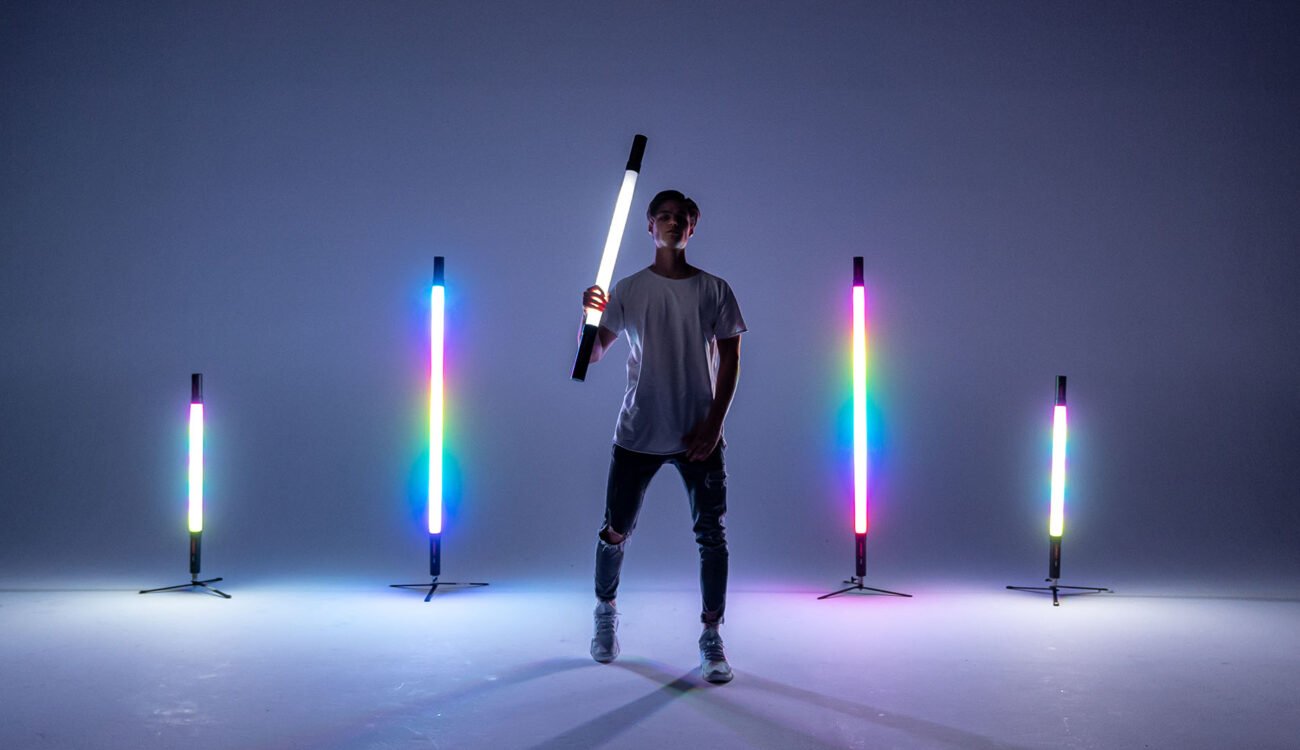
Tubular LED lights stand on their own bases and glow along the length of the tube, which is what makes them so effective at filling a space with colour. The version pictured here runs through white, blue, green, pink, purple and red instead of a single fixed tone, so one fixture can carry a whole colour scheme and be re-tuned for a different room or a different occasion.
Because they are freestanding, nothing has to be drilled or wired, which makes them the safest way to try a bold lighting idea before committing to anything permanent. The trade-off is that colour-changing light is the least flattering option for a room you use every single day.
- Pros: No wiring or installation; a wide colour range from a single fixture; strong visual impact for events and photography.
- Cons: Colour-changing light can distort skin tones and food colours; stands and cables take up floor space; many models are not dimmable, so check before planning to use a dimmer switch.
2. LED Spotlights And Downlights For Accent And Task Lighting
Small LED spotlights and downlights are the workhorses of indoor lighting. Fitted into a ceiling or mounted along a soffit, they throw defined cones of light onto a wall, a shelf or a work surface, and that wall-washing effect is what gives a room its depth.
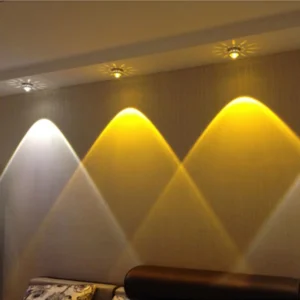
The key variables are beam angle and colour temperature. In the shot above, cool white and warm white fittings sit side by side, and the contrast is deliberate: cool light reads brighter and more clinical, while warm light softens the same surface. Mixing the two across one room is a straightforward way to stop a single ceiling from looking flat.
- Pros: Precise, controllable pools of light; low running cost compared with halogen equivalents; long working life in daily use.
- Cons: Fixed once installed, so the aim cannot be changed later; dimming and switch compatibility varies between fittings, so check the fitting before you buy.
3. LED Flood And Landscape Lights For Outdoor Use
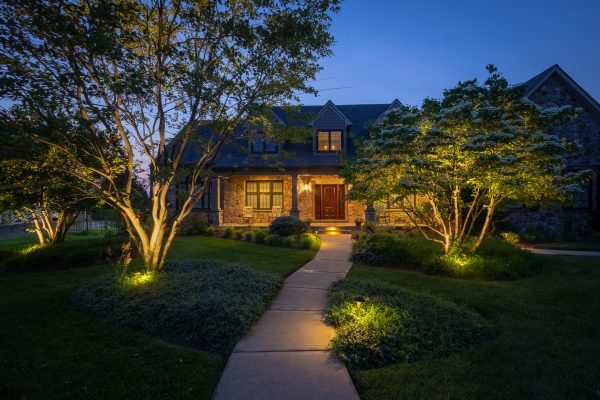
Outdoor lighting is a different problem. The goal is not to light a room but to shape the space around the building: washing tree trunks, marking a path, and lifting a facade off the night sky. Flood and landscape fittings are built for that, and they are rated for weather rather than for looks alone.

Placed at the base of a tree, an uplight makes the canopy look larger; placed along a walkway, a small path light handles the safety job. The rule of thumb is to keep the light source hidden or low, so that you notice the effect rather than the bulb.
- Pros: Extends usable space after dark; weather-rated housings suit year-round use; low power draw suits continuous operation.
- Cons: A fixed position is hard to correct after installation; bright fittings aimed at a neighbouring window create glare; cabling or a suitable outdoor socket has to be planned first.
4. Warm White LED String Bulbs For Ambient Light
Festoon-style string bulbs remain the simplest way to add soft light without touching a socket. The bulbs shown here are small C9 teardrop shapes on a dark wire, and the specification markers on the image read 0.5W, 2700K and E12, a low-wattage, warm-white, candelabra-cap bulb.
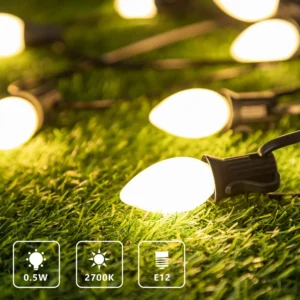
Two details decide whether string lighting works. Warmth matters most, because 2700K reads as soft and flattering and pairs well with wood, fabric and dining furniture. Cap type matters next, because E12 and E14 fittings are not interchangeable, and mixing them within one set leaves you with dark bulbs.
- Pros: Quick, low-impact way to add atmosphere; warm tone flatters most interiors; low power draw per bulb makes the set easy to run for long evenings.
- Cons: Not a substitute for task lighting; exposed bulbs collect dust and need regular wiping; bulbs and cables wear faster outdoors than in.
5. Moon And Galaxy Globe Lamps For Soft Night Ambience
Globe lamps turn a lighting decision into a decor decision. The lamp pictured rests on a light wooden X-stand and carries a printed or projected galaxy pattern across the surface, so the light it throws is diffuse and patterned rather than aimed at anything in particular.

They work best as a secondary light, on a bedside table, a console or a shelf, where the point is the glow rather than the brightness. Because the pattern is part of the object itself, they suit rooms with a softer, more decorative character than a workspace.
- Pros: Doubles as decor; diffuse, glare-free glow; a clear focal point for an otherwise plain corner.
- Cons: Low light output, so it cannot replace a main light; the printed or projected pattern can show wear over time; the physical size limits where it can be placed.
6. 3D LED Lamps For Decorative Accent Pieces
3D LED lamps push the decorative idea further. The lamp in the picture is a heart outline formed from a glowing floral pattern of roses, blossoms and leaves, standing on a tiered base with a coloured rim. It is an object first and a light source second.

These make the strongest shelf pieces and gifts, and they are the easiest to place because they need no fitting and no wiring at all. Their weakness is the same as the globe lamps: the light they give is atmospheric, not functional.
- Pros: Strong decorative impact with no installation; a clear statement piece for a shelf, desk or bedside table; a ready-made gift.
- Cons: Limited functional light output; the footprint is larger than photos suggest; the coloured base light can be distracting in a shared room.
Buying Checklist: What To Confirm Before You Buy
Whatever type you settle on, the same handful of checks will save you a return. Run through them before you order.
- Colour temperature. Decide warm or cool by the room: warm for living and bedroom areas, cool for kitchens and workspaces.
- Cap type and fitting. E12, E14 and GU10 are not interchangeable, so confirm the socket or fixture you already have.
- Dimming and switches. If you plan to use a dimmer or a smart switch, check that the lamp is listed as compatible.
- Power source. Mains, battery, USB or solar changes both the install and how freely the lamp can be moved later.
- Weather rating for outdoor fittings. Any lamp exposed to rain needs an appropriate rating before it goes outside.
- Physical size. Measure the shelf, the ceiling recess or the table first; decorative lamps read far larger in person than in photos.
- Whether the lamp will be seen switched off. For an always-visible fitting, how it looks unlit matters as much as the light itself.
Conclusion: Which LED Lamp Fits Your Space
There is no single best LED lamp, and the honest answer depends on the job rather than the specification sheet. If you want colour and impact for an event, tube lights win. If you want a room to have depth and shape, spotlights and downlights do the work. If the space is outside, flood and landscape fittings are the only sensible option. And for a soft, warm, low-effort glow, string bulbs and globe lamps are hard to beat.
Whichever you choose, decide the job before the fixture. Match the light distribution to the surface you need to see, match the colour temperature to the mood of the room, and confirm the fitting and power source against what you already have. Get those three right and the rest of the decision becomes straightforward.
Frequently Asked Questions
Can LED lamps be used in any existing light fitting?
Only where the cap or fitting matches. E12, E14 and GU10 bulbs are not interchangeable, and enclosed or dimmable fittings can restrict your choice further, so check the fitting and any dimmer you plan to use before you buy.
Do LED lamps get hot like halogen bulbs?
Not in the same way. LEDs still produce some heat, but far less at the fixture, and most of what is generated is carried away at the base rather than radiated forward. That is why LED lamps are generally easier to handle and comfortable to leave switched on.
Is it worth matching colour temperature across a whole room?
Matching the tone across a room makes the space look consistent and intentional. A deliberate mix of warm and cool in the same room also works, and it is a common way to make a ceiling-lit space feel less flat.
Are decorative LED lamps useful as the main light in a room?
No. Globes, heart lamps and similar pieces are designed as accent lighting. They set the mood of a corner and look good switched on, but they are not a substitute for a main light that actually illuminates the room.